Hepatitis B vaccine: who needs it, when, and the accelerated 0/7/21 schedule
A practical guide to the Hepatitis B vaccine in 2026 — risk groups, schedules, and what to do if you have only a few days before you fly.
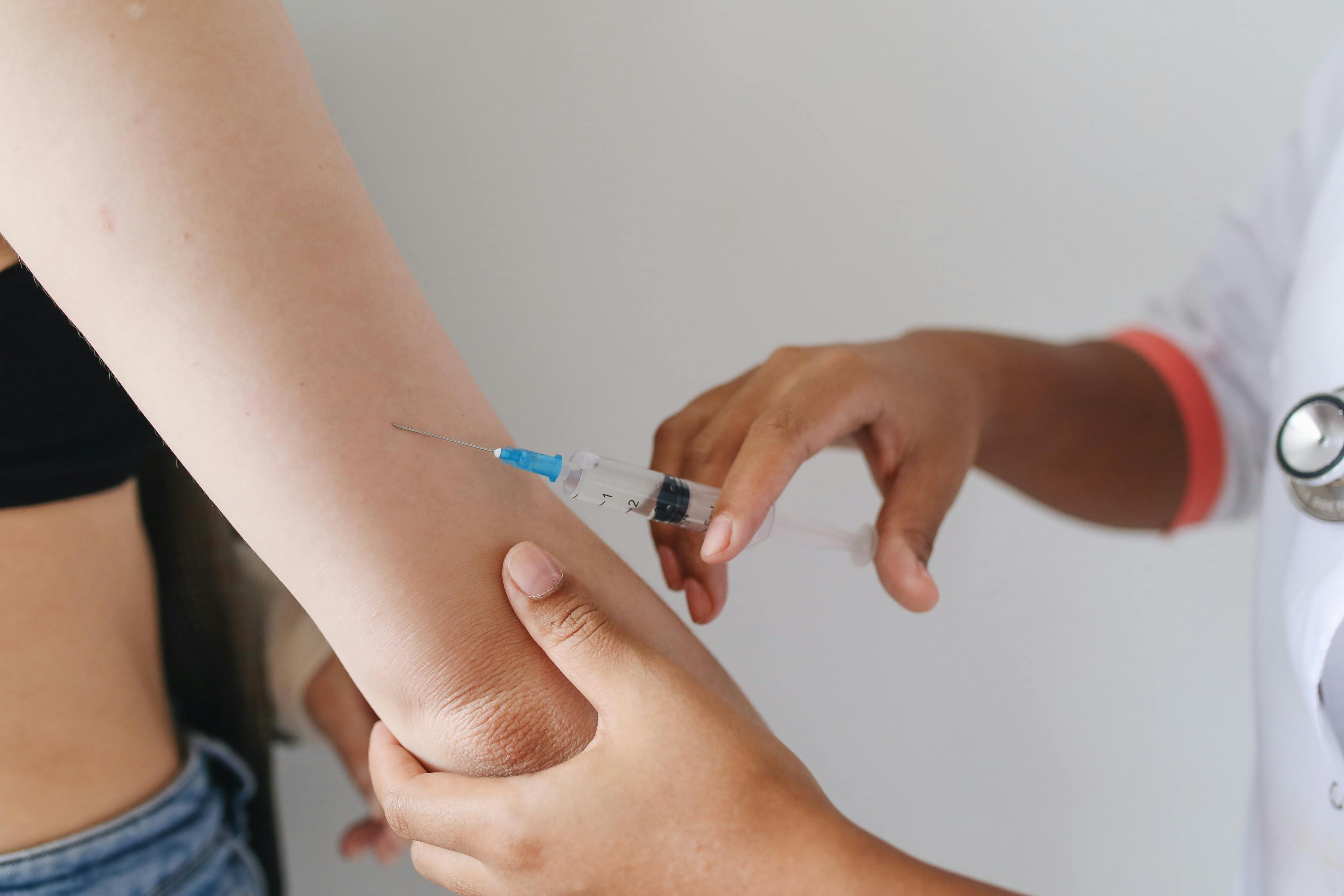
Hepatitis B vaccination, explained without the jargon
Hepatitis B is one of the most preventable serious infections we see in travel and occupational health. The virus is transmitted through blood, sexual contact, percutaneous exposure and from mother to child at birth — and roughly 240 million people worldwide live with chronic infection. The vaccine is highly effective: a completed course gives more than 95% of recipients lifelong protection. At Trafford Clinic, operated by Empire Pharmacy (GPhC premises 1123966) in Old Trafford, we run the full schedule from a single 0/1/6-month standard course through to last-minute 0/7/21-day accelerated courses for people flying within the month. This guide explains who needs the vaccine, how to choose between schedules, what to do about anti-HBs antibody testing, and what happens for the small minority who do not respond.
What hepatitis B is and how it is transmitted
Hepatitis B is a DNA virus that targets the liver. Acute infection can be mild or symptomatic with jaundice, dark urine and right-upper-quadrant pain. The bigger problem is chronic infection: roughly 5% of adults who catch it become chronic carriers, and chronic carriage drives cirrhosis and hepatocellular carcinoma over decades. Risk of chronicity is much higher in infants infected vertically — close to 90% — which is why the UK now includes hepatitis B in the routine 6-in-1 vaccine given at 8, 12 and 16 weeks.
Transmission routes are well characterised. Sexual contact accounts for most adult UK cases. Percutaneous exposure covers needlestick injuries, shared injecting equipment, unsterile tattoos and piercings, and certain medical or dental procedures abroad. Vertical transmission from an infected mother is the major route globally. Household transmission via shared razors, toothbrushes or shared injection devices also occurs but is less common. The virus is roughly 50–100 times more infectious than HIV in blood-to-blood exposure, and survives on surfaces for up to a week.
Who needs the vaccine
Several groups are clearly indicated:
- Travellers to countries of intermediate or high prevalence — much of Asia, sub-Saharan Africa, the Pacific, parts of South America and parts of Eastern Europe. Risk rises with length of stay, healthcare contact, sexual contact, body modification (tattoos and piercings abroad), and adventure activities that risk injury.
- Healthcare and dental workers, laboratory staff handling blood, paramedics and care workers who may be exposed to blood or body fluids.
- People who inject drugs, sex workers, men who have sex with men, and people with multiple sexual partners.
- Household and sexual contacts of someone with chronic hepatitis B.
- Patients on haemodialysis, those receiving regular blood products, and people with chronic liver disease (including chronic hepatitis C).
- Prison inmates and staff, certain emergency service workers, and tattoo artists.
The UKHSA Green Book chapter 18 is the definitive source of UK indications. For travellers, we follow the destination-specific advice from NaTHNaC TravelHealthPro.
The standard 0/1/6 schedule
The conventional course uses Engerix B or HBvaxPro at 0, 1 and 6 months. Three injections into the deltoid, monovalent products in the UK. This schedule is the best-studied and gives the cleanest long-term antibody response. If you have several months before you travel or before starting a high-risk occupation, this is what we usually recommend.
The accelerated 0/7/21-day schedule
Engerix B is also licensed in adults for an accelerated 0, 7 and 21-day schedule with a booster at 12 months to consolidate long-term protection. We use this routinely for travellers who have booked late, for healthcare students starting a placement, and for occupational settings where exposure risk begins within four to six weeks.
You finish the primary course in three weeks rather than six months. Real-world seroprotection rates after the third dose of the accelerated course are slightly lower than the standard schedule at the same point — typically around 65–75% at day 28 — but the 12-month booster brings the long-term protection rate to the same level as the standard schedule.
A very rapid 0/7/14-day variant is also used in some occupational settings; this is unlicensed but supported by Green Book guidance in specific circumstances.
Twinrix and combined hepatitis A/B vaccines
Twinrix is the combined hepatitis A + B vaccine. It is given at 0, 1 and 6 months for a standard schedule, or 0, 7, 21 days and 12 months for accelerated. The advantage is one needle rather than two when you need both vaccines. We frequently use Twinrix for travellers heading to South Asia, the Middle East and sub-Saharan Africa where both diseases are endemic.
If you have already had hepatitis A immunisation, monovalent hepatitis B (Engerix B or HBvaxPro) is the right product rather than Twinrix.
Anti-HBs antibody titres — when to check
An anti-HBs titre >10 mIU/mL is taken as evidence of protective immunity. Routine post-vaccination testing is not recommended for healthy travellers because the vaccine works in >95% of adults under 40 who complete the schedule. We do check titres in:
- Healthcare workers (occupational health requirement).
- Patients on haemodialysis or with chronic kidney disease.
- Immunocompromised patients — including those on chemotherapy, biologic therapies and high-dose steroids.
- Patients over 40, where response rates fall.
- People with known household exposure or after needlestick injury.
If you need an anti-HBs blood test, we draw it 4–8 weeks after the third dose at our Manchester blood test clinic. See reading blood test results in plain English for context on how reference ranges are set.
Non-responders: what we do
About 5–10% of adults do not mount a protective response even after three correctly-timed doses. Risk factors include age over 40, male sex, obesity, smoking and chronic illness. Options:
- Repeat the three-dose course with the standard product. About half of non-responders convert.
- Switch to a higher-antigen product — Fendrix (40 mcg) is licensed for adults on dialysis and pre-dialysis.
- Double-dose Engerix B (40 mcg) is used off-licence for some immunocompromised patients.
- Persistent non-response — usually managed in occupational health or hepatology. After two complete courses with no response, further doses are unlikely to help and the patient is counselled on the residual risk.
Post-exposure prophylaxis
If you have a high-risk exposure — needlestick injury, sexual contact with a known carrier, mucous membrane exposure to infected blood — accelerated vaccination plus hepatitis B immunoglobulin (HBIG) within 24 hours is the standard response. HBIG is administered in NHS emergency departments and occupational health services rather than primary care.
Side effects and practical notes
The vaccine is well tolerated. Common side effects are sore arm, low-grade fever and mild fatigue for 24–48 hours. Serious adverse events are very rare. The vaccine is inactivated, so it is safe in pregnancy and during breastfeeding (see our guide on pregnancy travel vaccines). The minimum age in the standard product is 11 years; paediatric formulations cover younger children — see child travel vaccines and minimum ages.
How we book your course at Trafford Clinic
Pharmacist Haroon Iqbal MPharm, IP (GPhC reg. 2051093) takes a structured travel and occupational history at your first visit. Haroon confirms which schedule suits your timeline, gives the first dose, books the subsequent doses, and (if relevant) sets up your anti-HBs blood test. We coordinate with your other travel vaccines — common combinations include hepatitis A, typhoid and rabies for South Asia, or yellow fever plus hepatitis A for sub-Saharan Africa. See our Manchester travel clinic page, or our local pages for Old Trafford, Rusholme, Sale and Altrincham.
For destination-specific risk profiles, see our country guides — Thailand, India and Pakistan are the most commonly requested. Travellers heading to Hajj or Umrah may also need meningococcal ACWY alongside their hepatitis B course. If you need malaria advice, see Malarone, doxycycline and mefloquine compared, and for the yellow fever certificate see ICVP requirements.
When to start
If you have six months, take the standard course. If you have three to five weeks, use accelerated. If you have less than two weeks, take what doses you can — one or two doses still gives meaningful partial protection, and the schedule can be completed on return. Do not delay starting because you cannot complete the course before departure.
Key points from this guide.
Quick summary before you read the detail.
95%+ protected after course
Standard 0/1/6 schedule
Accelerated 0/7/21
Indicated for many groups
Twinrix covers Hep A too
Anti-HBs testing matters
What to do next.
Three steps after reading.
Pick the right schedule
Combine where possible
Check antibodies if needed
About this guide.
Walk-in welcome Monday to Saturday. Same-day bookings available most of the time.
- Mon09:00 – 19:00
- Tue09:00 – 19:00
- Wed09:00 – 19:00
- Thu09:00 – 19:00
- Fri09:00 – 19:00
- Sat09:00 – 17:00
- SunClosed
Related questions
If your question isn't here, give us a call and we'll talk it through.
References for this page
Every clinical claim above is sourced from an authoritative public reference.
- 01
- 02
- 03
- 04
- 05
Information on this page is general guidance from Trafford Clinic, operated by Empire Pharmacy (GPhC premises 1123966). It is not a substitute for individual clinical assessment.