Travelling with children: vaccine schedules and minimum ages
A practical, age-by-age guide to travel vaccines and malaria tablets for children — including paediatric formulations and the routine schedule.
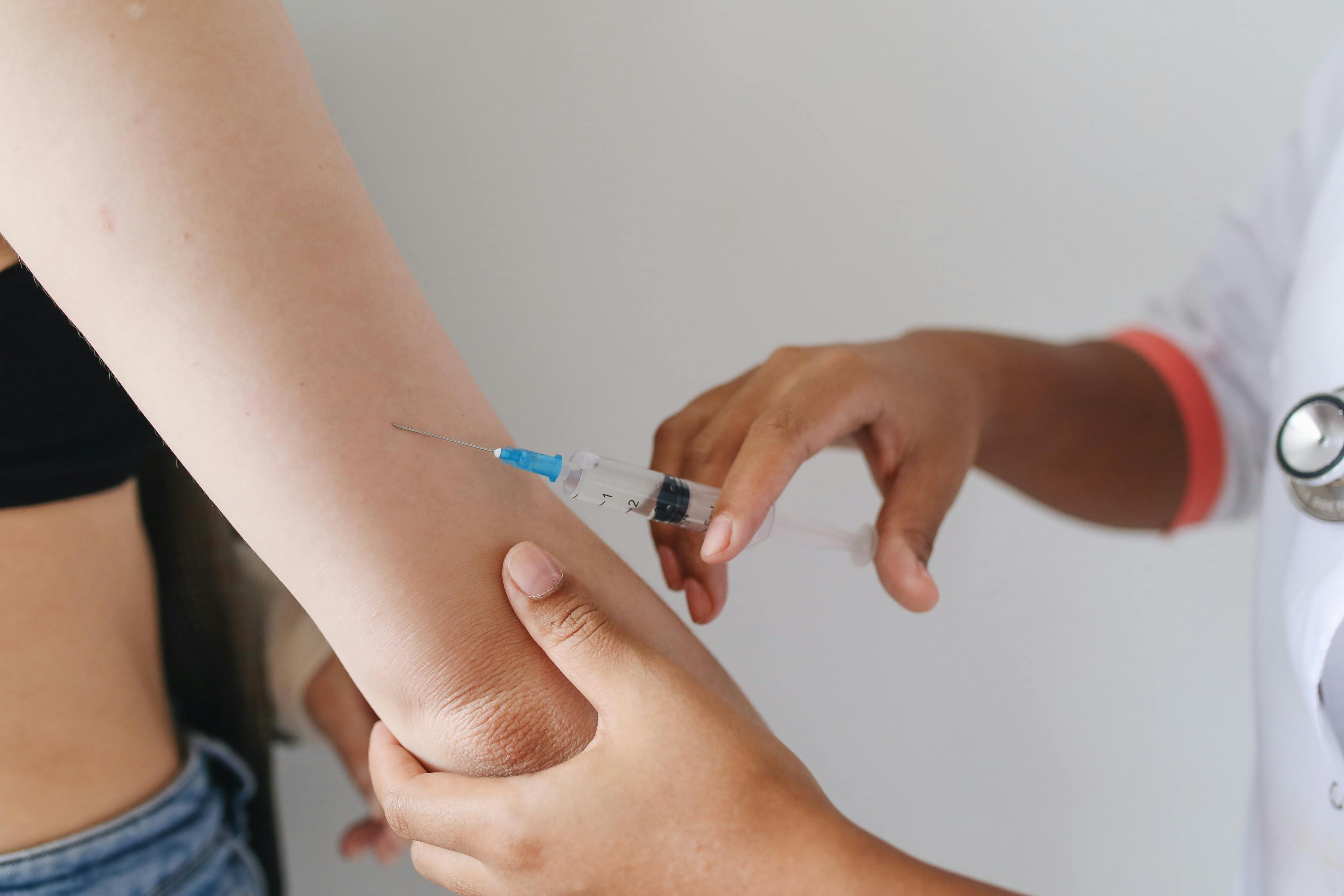
What you can and cannot give a child before travel
Travelling with children adds a layer of planning to any trip. The big questions parents ask us at Trafford Clinic are predictable: is my child old enough for the vaccines they need; can we use malaria tablets safely; what about catch-up of the routine UK schedule before we go; and how do we manage the visit itself with a nervous child. This guide, written by pharmacist Haroon Iqbal MPharm, IP (GPhC reg. 2051093), walks through every travel vaccine, gives the minimum age for each, flags the paediatric formulations where they exist, and covers malaria chemoprophylaxis from infancy upwards. Trafford Clinic is operated by Empire Pharmacy (GPhC premises 1123966) and routinely vaccinates children from 9 months of age for travel.
First, the UK routine schedule
Before any travel discussion, check your child is up to date with the routine NHS schedule. This is the foundation and it is free. It covers diphtheria, tetanus, pertussis, polio, Hib, hepatitis B (in the 6-in-1), rotavirus, pneumococcus, MenB, MMR and the pre-school booster. If your child is behind, the GP or health visitor can usually catch up before travel, especially if you have several weeks. The MMR is particularly important — measles is currently circulating in parts of Europe, North Africa and South Asia, and missed MMR is the single most common preventable reason a UK family child gets ill abroad.
For travel-specific vaccines, work outwards from your child's age. Here is the practical map.
From birth: hepatitis B
Paediatric Engerix B (10 mcg) and HBvaxPro Paediatric (5 mcg) are licensed from birth. The vaccine is given in the routine 6-in-1 to all UK babies at 8, 12 and 16 weeks. Additional doses for travel purposes are rarely needed before 6 months. For older children with no prior hepatitis B who are heading to a high-prevalence destination, the standard 0/1/6 or accelerated 0/7/21 schedule applies. See our guide on the hepatitis B vaccine and our local vaccine page.
From 2 months: Japanese encephalitis
Ixiaro is licensed from 2 months. It is rarely needed for short tourist itineraries in South or Southeast Asia, but indicated for rural exposure, monsoon-season travel and longer stays. The schedule is two doses 28 days apart (children under 3 get the half-dose; from 3 years upwards the adult dose).
From 9 months: Yellow Fever
Stamaril is the only Yellow Fever vaccine licensed in the UK and is given from 9 months of age. Below 9 months, the vaccine is contraindicated due to risk of encephalitis. Between 6 and 9 months it can be considered in extreme cases under specialist advice. The certificate (ICVP) is required for entry to many sub-Saharan African and Latin American countries — see ICVP requirements 2026.
From 12 months: hepatitis A and MMR
Havrix Junior, Avaxim Junior 80U and VAQTA Paediatric are all licensed hepatitis A vaccines from 12 months. Two doses 6–12 months apart give long-term protection. MMR is part of the UK routine schedule from 12 months and the second dose is at 3 years 4 months; if travelling, both doses can be brought forward (the second from 4 weeks after the first if needed).
From 2 years: typhoid and cholera
Typhim Vi (inactivated injectable typhoid) is licensed from 2 years. Oral Vivotif (live attenuated Ty21a) is licensed from 6 years and is taken as three capsules over five days. We use injectable typhoid most often because it is one dose and easier with children. Dukoral (oral killed cholera vaccine) is licensed from 2 years and is the practical choice for children travelling to endemic areas with limited safe water access.
From 2 years: meningococcal ACWY
Menveo, Nimenrix and MenQuadfi are conjugate ACWY vaccines licensed from various ages — Nimenrix from 6 weeks, Menveo from 2 years, MenQuadfi from 12 months. Meningococcal ACWY is required for travel to Hajj and Umrah (Saudi Arabia entry requirement) and recommended for travel to the African meningitis belt during the dry season. The vaccine is also part of the UK routine schedule for adolescents at 14 years. See Hajj 2026 vaccination guide for family planning.
No minimum age: rabies pre-exposure
Rabipur and Rabies BP have no formal minimum age and are routinely given to infants travelling to rabies-endemic countries when the trip involves contact with animals, remote locations or long stays. Toddlers are particularly at risk because they grab at dogs and cats and may not report a bite. The schedule is three doses on days 0, 7 and 21–28. After exposure, two further doses are needed even if previously vaccinated — pre-exposure vaccination simplifies the response and avoids the need for human rabies immunoglobulin (which is hard to source in many countries).
Malaria chemoprophylaxis in children
This is where weight, age and product interact:
- Malarone (atovaquone-proguanil) Paediatric tablets — licensed from 11 kg (roughly 1 year). The paediatric tablet is one-quarter the strength of the adult tablet. Dosing is by weight: 11–20 kg one tablet, 21–30 kg two tablets, 31–40 kg three tablets, >40 kg adult dose. Taken with food once daily, starting 1–2 days before entering the malaria area and continuing 7 days after leaving. Best tolerated of the prophylactic options in children.
- Chloroquine + proguanil — historically used in children; now only effective in a small number of destinations. Still has a place in pregnant or very young children in chloroquine-sensitive areas.
- Mefloquine (Lariam) — licensed from 5 kg in some countries; in the UK rarely used in children under 5. Side effect profile (vivid dreams, mood change) makes it a poor first choice.
- Doxycycline — contraindicated under 12 years. Tetracyclines bind to developing teeth and bones, causing permanent yellow-grey staining.
See our standalone comparison of malaria tablets for adult dosing.
Practical tips for the appointment itself
- Talk to your child in advance — honest, brief, no scary detail. "You'll feel a quick pinch and it will be done."
- Distraction — phone video, story, bubble blowing, breathing exercises. Older children respond well to counting backwards.
- Dual-arm vaccination — we routinely give two vaccines into separate deltoids/thighs in one visit to reduce total visits. Discomfort is per-arm so it is no worse overall.
- Topical anaesthetic cream (Emla, Ametop) — applied 60 minutes before the visit; helpful for needle-phobic children. Bring it with you and we will time accordingly.
- Comfort and reward — sticker, treat, a quiet sit-down after the injection. Avoid sugary celebrations that conflate the visit with reward.
Planning your child's appointment at Trafford Clinic
Bring the Red Book (the UK child health record) if you have it — we copy the relevant pages so the travel vaccines sit alongside the routine record. If you are travelling within a month, tell us at booking so we can sequence accelerated schedules and combine vaccines into one or two visits rather than three. For sibling groups, we book consecutive slots so the same parent can stay with each child.
See our local pages for family-heavy areas — Sale, Altrincham, Stretford and central Manchester. Destination guides are available for India and Thailand, the two most frequently requested family destinations. Pregnant family members should also see our guide on pregnancy travel vaccines.
Key points from this guide.
Quick summary before you read the detail.
Routine UK schedule first
9 months for Yellow Fever
12 months for Hep A
2 years for typhoid
Malarone from 11kg
Rabies has no minimum age
What to do next.
Three steps after reading.
Bring the Red Book
Combine visits for siblings
Plan accelerated where needed
About this guide.
Walk-in welcome Monday to Saturday. Same-day bookings available most of the time.
- Mon09:00 – 19:00
- Tue09:00 – 19:00
- Wed09:00 – 19:00
- Thu09:00 – 19:00
- Fri09:00 – 19:00
- Sat09:00 – 17:00
- SunClosed
Related questions
If your question isn't here, give us a call and we'll talk it through.
References for this page
Every clinical claim above is sourced from an authoritative public reference.
- 01
- 02
- 03
- 04
- 05
Information on this page is general guidance from Trafford Clinic, operated by Empire Pharmacy (GPhC premises 1123966). It is not a substitute for individual clinical assessment.