Hajj 2026 vaccination guide: what Saudi Arabia requires and recommends
Everything UK pilgrims need to know about Hajj 2026 vaccines — the Saudi MOH mandatory rules, the strongly recommended jabs, and how to time your certificate so you're never refused entry.
Honest answers, before you commit.
Hajj 2026 falls in late May and early June. The Saudi Ministry of Health updates its mandatory vaccination rules every year, and the rules for 2026 carry one change pilgrims often miss: Menveo (Meningococcal ACWY conjugate) must be administered at least ten days before arrival in the Kingdom, and the certificate must be valid for five years from the date of vaccination. If you arrive without it, you can be turned around at Jeddah or Madinah. This guide walks through every vaccine — mandatory, recommended, and situationally important — with the timing windows that actually matter. It's written by Haroon Iqbal MPharm, IP, our superintendent pharmacist at Empire Pharmacy and the lead clinician at Trafford Clinic.
The one mandatory vaccine: Menveo for Meningococcal ACWY
Saudi Arabia requires every pilgrim aged one year and over to present a valid certificate of vaccination against meningococcal disease (serogroups A, C, W and Y) before entering the country for Hajj or Umrah. The rule has been in place since the Hajj meningitis outbreaks of 2000 and 2001 and is enforced at port of entry. The certificate must show vaccination at least ten days before arrival in the Kingdom and not more than five years before arrival for the conjugate vaccine (or three years for the older polysaccharide vaccine, which is rarely used in the UK now).
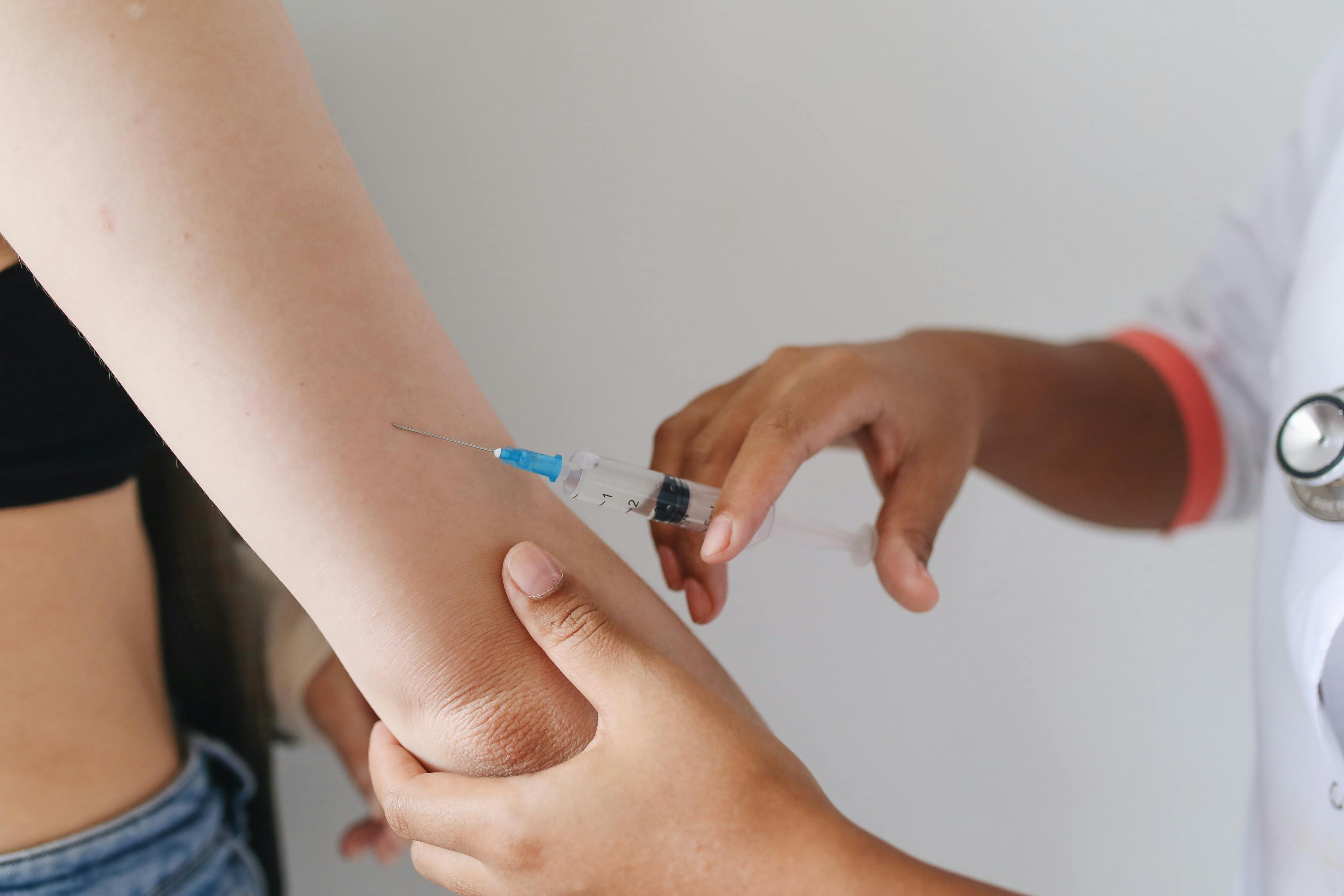
At Trafford Clinic in Manchester we use Menveo, a conjugate ACWY vaccine that gives broader and longer-lasting immunity than the older polysaccharide product. It's a single intramuscular injection, well tolerated, with the most common side effects being a sore arm for 24–48 hours and occasional mild fever. You'll receive an official yellow vaccination card stamped by our Yellow Fever Vaccination Centre (Empire Pharmacy, GPhC premises 1123966) — this is the document Saudi border officials want to see.
If you had Menveo for a previous Umrah or Hajj within the past five years, you don't need it again. Bring your old yellow card to the appointment and we'll verify the date.
Polio: only for travellers from listed countries
Saudi Arabia's polio rule is often misunderstood. UK pilgrims travelling directly from the UK do not need a polio vaccine for Hajj. The Saudi MOH publishes a list of countries from which polio vaccination is required, and that list is updated annually based on WHO surveillance data. As of the 2026 cycle, the list includes Afghanistan, Pakistan, Nigeria, Yemen, Somalia, and several others with active wild poliovirus or circulating vaccine-derived poliovirus transmission.
The rule applies based on country of residence in the previous 12 months, not just citizenship. If you have lived for four weeks or more in any listed country in the past year, you'll need an oral polio vaccine (OPV) or inactivated polio vaccine (IPV) dose between four weeks and twelve months before arrival, with proof on a yellow card. This catches British Pakistani pilgrims who have spent extended time visiting family — something we see often at our travel clinic in Rusholme. If you're unsure, bring your travel history to the appointment.
Strongly recommended (not mandatory, but you should have them)
Hajj is a perfect storm for respiratory and gastrointestinal infection. Two to three million people share crowded sleeping quarters in Mina, eat from communal kitchens, share ablution facilities, and pray shoulder to shoulder. The Saudi MOH and the UK's NaTHNaC (National Travel Health Network and Centre) recommend several vaccines that aren't legally required but are clinically very sensible.
- Seasonal influenza: Hajj clusters of flu are well documented. A single intramuscular dose at least two weeks before travel covers you.
- Hepatitis A: Food and water contamination risk in communal kitchens. Two doses 6–12 months apart give long-term protection; one dose gives short-term cover for the trip.
- Typhoid: Same rationale as Hep A — communal food prep. Single intramuscular dose, lasts three years.
- Whooping cough (pertussis): Adult immunity wanes by mid-life. The Tdap booster also covers tetanus and diphtheria. We discuss this with anyone over 40.
- COVID-19: Saudi Arabia has dropped formal COVID entry requirements but recommends being up to date with the seasonal booster, especially for older pilgrims and those with respiratory conditions.
For the full picture see our Saudi Arabia travel health page.
Pilgrims with Africa side trips: malaria and yellow fever
A small but growing number of British Muslims combine Hajj with onward travel — visiting family in Sudan, Ethiopia, Somalia, or Nigeria, or stopping over in Egypt. If your itinerary includes any sub-Saharan African country with malaria transmission, you'll need malaria prophylaxis on top of the Hajj vaccines. Choice of tablet (Malarone, doxycycline or mefloquine) depends on destination, length of stay, and your medical history. See our dedicated comparison guide for the trade-offs.
Yellow fever certification is required for entry to Saudi Arabia from any country with yellow fever transmission risk — even on transit. Our Manchester travel clinic is a NaTHNaC-designated Yellow Fever Vaccination Centre, so we can issue the ICVP (International Certificate of Vaccination or Prophylaxis) in the same visit.
Pilgrims on GLP-1 medications: practical considerations
An increasing number of our patients are taking Mounjaro or Wegovy for weight management. If that's you, the heat, dehydration, and fixed meal times at Hajj need planning. The injection pens must be kept between 2°C and 8°C until first use, then can be stored at room temperature up to 30°C for 30 days (per the Mounjaro SmPC). Saudi temperatures in the Hijaz region during Hajj exceed 40°C, so you'll need a cool bag and a clear plan. We've written a separate guide: travelling internationally on Mounjaro or Wegovy.
Certificate workflow and timing
The single biggest reason pilgrims get refused boarding or refused entry isn't missing a vaccine — it's a paperwork timing error. Here's how it works:
- Eight to twelve weeks before travel: Book a travel consultation. Bring your old yellow card if you have one, your itinerary, and a list of medications.
- Six to eight weeks before: Receive Hepatitis A (dose 1), Typhoid, Tdap (if needed). These take a few weeks to reach peak immunity.
- Two to four weeks before: Receive Menveo and the seasonal flu jab. Menveo's ten-day pre-arrival window starts from this date — make sure you don't fly within ten days of injection.
- At the appointment: We issue your yellow ICVP card with practice stamp, GPhC premises number, and Haroon's signature. Photograph both sides and keep digital copies.
If you're flying within ten days and haven't had Menveo yet, you have a problem — Saudi border control will not accept the certificate. Book early.
What to bring to your appointment
- Old yellow vaccination card, if you have one
- List of current medications (especially blood thinners, steroids, biologics)
- GP letter for any immunosuppression, recent chemotherapy, splenectomy, or pregnancy
- Your Hajj group operator details (in case we need to verify the itinerary)
If you're elderly, pregnant, immunocompromised, or have a complex medical history, we'll spend extra time on risk assessment. Haroon is an Independent Prescriber (GPhC reg. 2051093) and can adjust the schedule or, in rare cases, exempt you from a specific vaccine with documented justification.
Costs and how to book
We charge per vaccine rather than a flat package, so the cost depends on what you actually need. For a typical UK-based first-time pilgrim with no special medical history, the full schedule (Menveo, flu, Hep A, Typhoid) is on our pricing page. We'll tell you the exact total at the start of the consultation so there are no surprises.
To book, visit traffordclinic.co.uk/booking or call 0161 258 6149. We have appointments at Old Trafford (Seymour Grove), with patients regularly travelling from across Greater Manchester — particularly our Rusholme catchment, central Manchester, Stretford and Salford. Empire Pharmacy is a NaTHNaC-designated Yellow Fever Vaccination Centre, so the yellow card we issue is the one Saudi authorities recognise.
Related reading: Malaria tablets compared, Travelling with Mounjaro or Wegovy.
Key points from this guide.
Quick summary before you read the detail.
Menveo is mandatory
10 days before arrival
Polio for listed countries
Recommended jabs matter
GLP-1 cold chain planning
Yellow ICVP card issued
What to do next.
Three steps after reading.
Book 8–12 weeks ahead
Stagger the schedule
Photograph the card
About this guide.
Walk-in welcome Monday to Saturday. Same-day bookings available most of the time.
- Mon09:00 – 19:00
- Tue09:00 – 19:00
- Wed09:00 – 19:00
- Thu09:00 – 19:00
- Fri09:00 – 19:00
- Sat09:00 – 17:00
- SunClosed
Related questions
If your question isn't here, give us a call and we'll talk it through.
References for this page
Every clinical claim above is sourced from an authoritative public reference.
- 01Saudi Ministry of HealthSOURCEHealth Requirements and Recommendations for Travellers to Saudi Arabia for Hajj and Umrahhttps://www.moh.gov.sa/en/Hajj/HealthGuidelines/Accessed 20 May 2026
- 02TravelHealthPro (NaTHNaC)TRAVELHEALTHPROSaudi Arabia country informationhttps://travelhealthpro.org.uk/country/197/saudi-arabiaAccessed 20 May 2026
- 03UKHSA Green BookSOURCEMeningococcal — chapter 22https://www.gov.uk/government/publications/meningococcal-the-green-bo…Accessed 20 May 2026
- 04electronic Medicines CompendiumSOURCEMenveo SmPChttps://www.medicines.org.uk/emc/product/5266/smpcAccessed 20 May 2026
- 05World Health OrganizationWHOInternational Travel and Healthhttps://www.who.int/publications/i/item/9789241580472Accessed 20 May 2026
Information on this page is general guidance from Trafford Clinic, operated by Empire Pharmacy (GPhC premises 1123966). It is not a substitute for individual clinical assessment.